Inquire from any student regarding his or her stressors for that exam period, and there is a likelihood that they will all answer by saying they always have too much work to do and too little time to revise. The above statement gets to be true especially when it comes to exams such as entrance examinations, whereby there is a lot of pressure and the syllabus looks like it goes on forever, with mistakes carrying dire repercussions.
What often gets ignored is that preparation also needs a filter. Students today read toppers’ strategies, compare coaching material, and even use tools like a chatgpt detector when they want to check whether academic writing sounds too machine-generated or too flat. Yet one of the most useful things in exam preparation is still surprisingly basic: spending serious time with previous year papers and learning how questions actually behave over time.
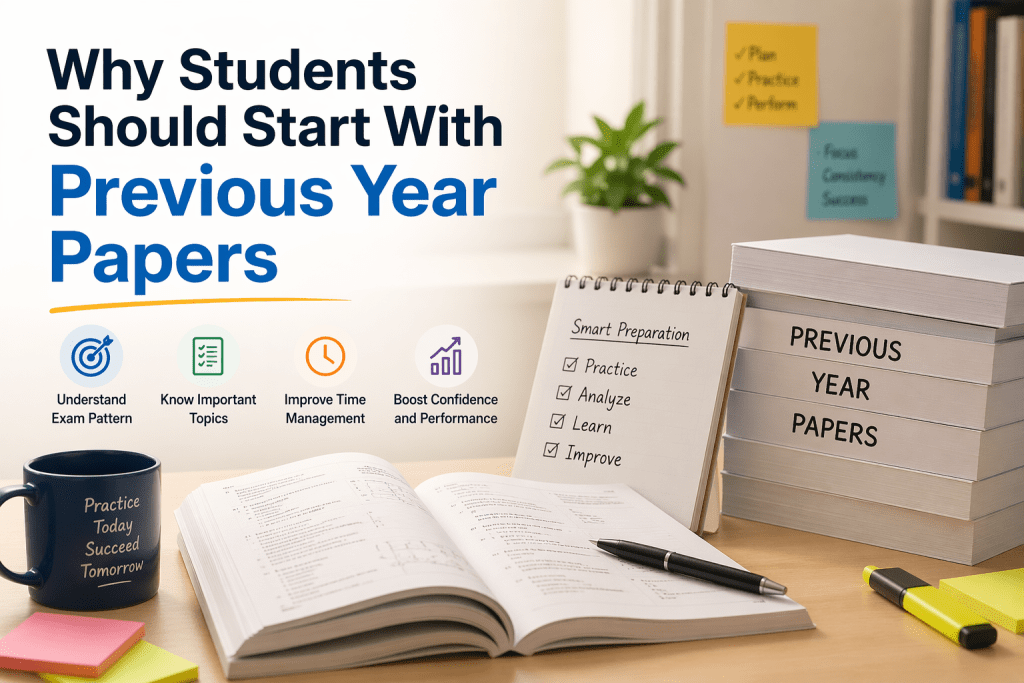
The paper teaches the exam in a way theory never can
A syllabus tells you what can appear. Last year’s question paper can offer insight into the type of content that typically comes up, how it is tested, and the depth of understanding required.
A chapter can look simple while the exam turns it into a trap through wording, sequence, or time pressure. Another topic may seem huge in the textbook but appear in predictable formats once you study enough real papers. This is where previous papers become more than practice material. They become a map of the exam’s personality.
Every exam has one. Some reward speed and elimination skills. Some test patience with long passages and layered reasoning. Some look moderate on content but become difficult because the paper is uneven, with a few questions designed to shake confidence. Students who spend enough time with older papers begin to notice these patterns. They stop treating the exam like a mystery and start seeing it as a structure.
That mental shift changes preparation. Instead of asking, “Have I finished the syllabus,” a student starts asking, “Can I handle the way this exam asks things?” That is a much stronger question.
Pattern recognition creates calm
One of the biggest hidden benefits of previous year papers is emotional. They reduce panic.
Students often think anxiety comes only from lack of knowledge. In reality, uncertainty plays an equally big role. A student may know the chapter well but still freeze when the actual paper looks unfamiliar. The problem is not always weak preparation. Sometimes the problem is that the brain has never practiced recognizing the exam environment.
Previous papers train recognition. After solving enough of them, certain things begin to feel normal:
- the recurring type of tricky question
- the chapters that return in different forms
- the balance between direct and application-based items
- the realistic speed needed to finish on time
This familiarity does not remove stress completely, but it changes its quality. Fear becomes focus. Instead of feeling that anything can happen, a student enters the exam room with the sense that most surprises will still belong to a known range.
That matters a lot in high-pressure exams. Calm students make fewer avoidable mistakes. They read more accurately. They recover faster after one difficult section. They also waste less time doubting themselves.
Most students use old papers the wrong way
There is a common mistake in the way previous year papers are used. Many students solve them only after “finishing everything.” By that stage, they use the paper as a test of memory rather than a tool of learning. That approach is too narrow.
Previous papers should appear early, not only at the end. Even if a student cannot solve the whole paper, reading through it in the early phase creates direction. It tells you what the exam values. It helps you see which topics are core, which are repeated, and which require deeper conceptual control.
Another mistake is solving papers casually without review. Students mark answers, count the score, and move on. But the score is only the surface. The deeper value comes from looking at three things:
- Where did I lose time
- Which mistakes came from confusion rather than lack of study
- Which question types keep pulling me into wrong choices
That review process is what turns practice into progress.
A good paper analysis session can be more valuable than solving two new mock tests without reflection. It is slower, but it creates more durable improvement.
How to turn old papers into a real strategy
The smartest way to use previous year papers is to assign each paper a purpose. Not every paper should be solved in the same mood or under the same conditions. Some are for diagnosis. Some are for timing. Some are for confidence rebuilding.
Here is a practical way to divide them:
- Use a few older papers to understand pattern and weightage
- Use mid-range papers to build topic-wise correction habits
- Use recent papers in full exam conditions with strict timing
This layered use helps because preparation is not a single activity. It includes learning content, adapting to format, fixing repeated errors, and improving decision-making.
It also helps to keep a simple error notebook. Not a massive notebook full of theory, but a narrow one focused on exam behavior. Write down the kind of mistakes that keep returning. Maybe you rush through graph-based questions. Maybe you overthink easy ones. Maybe you lose marks when two options look almost right. This notebook becomes more personal and useful than generic advice from strangers online.
There is also a timing lesson hidden inside old papers. Many students assume that time management means solving faster. Sometimes it really means choosing better. Previous papers teach you when to move on, when to return later, and when a question is trying to steal more time than it deserves.
The real benefit is maturity, not just marks
Students usually begin solving previous year papers because they want a better score. That is fair. But the deeper benefit is something else: academic maturity.
A mature student is not someone who studies all day. It is someone who understands the exam as a system. That student knows how content, pattern, pressure, and self-control interact. They do not chase every new source just because it exists. They become more selective. More observant. Less reactive.
This matters in entrance exam culture, where overload has become normal. Students are surrounded by advice, content dumps, crash courses, and endless productivity talk. In that noise, previous year papers offer something refreshingly honest. They bring the student back to the one thing that truly matters: how the exam has actually asked questions.
That is why old papers remain powerful year after year. They are grounded. They are concrete. They teach both content and behavior. And for many students, they become the turning point between studying a lot and studying with purpose.
In the end, strong preparation is rarely about doing everything. It is about doing the few right things with enough depth. Previous year papers belong in that category. They do not just help students revise. They help students see the exam clearly, and that clarity is often the advantage that changes the result.